

Mount Carmel at Home - 21/04/2020
Welcome to Mount Carmel at Home. These sessions will enable parents to carry out fun and educational home learning activities with their children. We recommend establishing a routine and setting aside a time in day for home learning. It is preferable to do these activities in the morning when children are more alert than towards the end of the day when they can be tired and less cooperative.
Share your child's learning with us by uploading photos and videos to their Learning Journey on Famly, by uploading on Instagram and adding the hashtag #MountCarmelatHome or posting on our Facebook page. Your child's teachers will love to see what you have been up to!
Click here to download today's activity sheet and resources.
The sound of the week is "G" - https://youtu.be/26uXtUYssuo?t=281
Today’s activities for preschool children
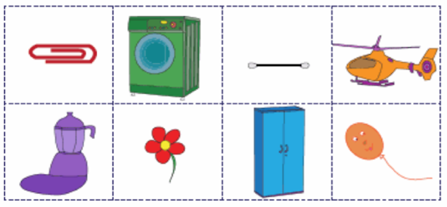
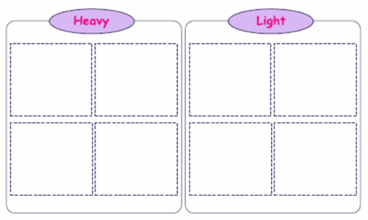
Activity 1 | Heavy and light sticking activity. |
What you’ll need | The heavy and light activity sheet, child safe scissors, glue. |
Method | Begin by cutting out the pictures of different items. Show them to your child and talk about them individually. Ask your child if they think the object is heavy or light (explain that light means ‘not heavy’). Once they have made a decision, show them where the heavy and light items need to be glued and let them stick each picture down. |
What did we learn? | Mathematics: Shape, space and measure Ordering two items by weight. Physical development: Moving and handling Uses one handed tools and equipment eg: makes snips in paper with children’s scissors. |
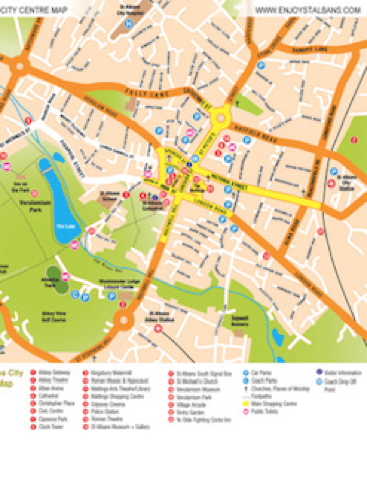
Activity 2 | Maps |
What you’ll need | Print of St Albans map from the activity sheet. |
Method | Invite your child to look at the map of St Albans. Ask your child if they know the town that they live in? Explain this is a map of St Albans town centre. Ask your child if they know why we use maps? Explain we use maps to help us to find places such as parks, hospitals or shops and they also help us to find specific roads. Look at the map with your child and point out the roads and that roads have names. Does your child know the name of their road? If your road is on the map show your child where it is. Explain to your child that maps have lots of symbols to help us find places. Show the symbol of a church on the map and ask your child how many churches can they find. Support your child to keep count if needed. Explain that St Albans has two train stations. Show your child one of the stations and it's symbol and ask you child if they can find the other station. Tell your child that there is a river in St Albans (you may have walked along it) and ask your child if they can find it. If needed you can help by asking what colour they think the river could be. Ask what shape a roundabout is, and then ask how many roundabouts/circles they can find on the map. If your child is enjoying this activity ask your child to find both stations and see if they can find a route along the roads from one station to the other. You may need to help by drawing a circle around each station or point to each station to help your child to focus where they are going. Your child could either use their finger or draw their route with a pencil. Maybe ask your child to find other routes, choose two points and ask your child if they can get from one to the other by following the roads. Questions and language that maybe useful; Can you see? Can you find? Streets, roads, buildings Are you lost? |
What did we learn? | Understanding the world (UW) We have asked questions and made comments about aspects of our familiar world such as the place we live. Literacy (L) We are learning to recognise familiar words and signs such as logos and we know information can be relayed in the form of print |
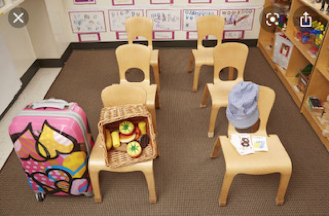
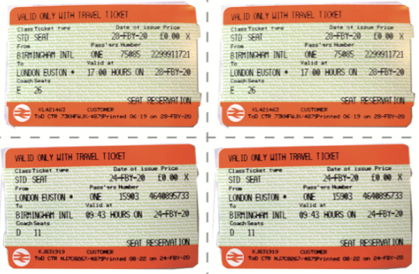
Activity 3 | Train role play |
What you’ll need | Chairs, cushions, tickets (either print from activity sheet, use old ones you may have around the house or maybe make your own), dice, siblings or dolls and teddies. |
Method | Say to your child, "Let's play trains". Ask your child to help you to set out the chairs or cushions in a line like a train carriage. Your child can be the train driver and ask them if they know where the driver sits and ask them to sit in that chair. The other children or dolls and teddies are the passengers and they need to wait on the 'platform' beside the train. Ask the driver to roll the dice. This decides the number of passengers who can board the train. Ask your child to count how many passengers can get on the train and how many tickets the driver needs to give out. Then throw again until the train is full. Off they go, choo choo! Then swap drivers and passengers before playing again. The play may extend to talking about where the train is going and what you are going to do when you get there. Questions and language that maybe useful; How many? How many more? Is there any more room on the train? Can all those people get on? How many tickets do you need? |
What did we learn? | Expressive arts and design (EAD) We are learning to engage in imaginative role-play based on own first-hand experiences and using available resources to create props to support role play Communication and language (CL) We are learning to build up vocabulary that reflects the breadth of our experiences. Personal, social and emotional (PSE) We are learning to play in a group, extending and elaborating play ideas, building up a role play with others and keeping the play going by responding to what others are saying or doing. Mathematics (M) We are learning to use counting and number names accurately in play |