

Mount Carmel at Home - 29/04/2020
Welcome to Mount Carmel at Home. These sessions will enable parents to carry out fun and educational home learning activities with their children. We recommend establishing a routine and setting aside a time in day for home learning. It is preferable to do these activities in the morning when children are more alert than towards the end of the day when they can be tired and less cooperative.
Share your child's learning with us by uploading photos and videos to their Learning Journey on Famly, by uploading on Instagram and adding the hashtag #MountCarmelatHome or posting on our Facebook page. Your child's teachers will love to see what you have been up to!
Click here to download today's activity sheet and resources.
The sound of the week is "O" - https://youtu.be/U2HYM9VXz9k?t=258
Theme: People that help us
Today’s activities for preschool children
Activity 1 - Shape Pictures
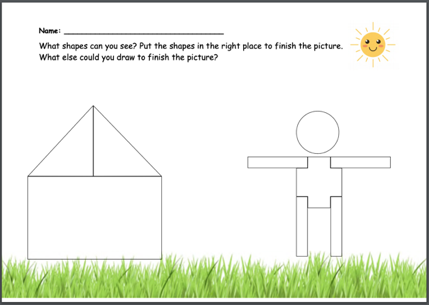
What you’ll need | The ‘Shape pictures’ sheets, scissors, glue, pens or pencils. |
Method | Cut out all of the coloured shapes (your child will probably need some help with this). Talk about the names of the different shapes and ask your child to identify each one. Next, show them the picture; explain that you will use the shapes to build a picture. Begin by pointing to the word ‘Name’ and ask your child what they think they need to write on the line. If they are under confident in writing their name support them either by writing along with them (write one letter at a time on a separate piece of paper for them to copy) or by writing their name in a light colour for them to trace over. Ask your child to place the shapes in the correct places and then glue them down. Try to allow them to be independent with this; especially if they have a shape the wrong way up etc, let them work it out by themselves. Finally, see if your child thinks they could add anything else to the picture with their pens or pencils. Ask them, “What is missing?”. |
What did we learn? | Mathematics: Shape, space and measures – Shows an interest in shape and space by playing with shapes or making arrangements with objects, shows an awareness of similarities of shapes in the environment, shows an interest in shape by sustained construction activity or by talking about shapes or arrangements uses shapes appropriately for tasks, selects a particular named shape. Expressive arts and design: Exploring and using media and materials – Constructs with a purpose in mind, manipulates materials to achieve a planned effect. |
Activity 2 - Paper Cup Walkie Talkies
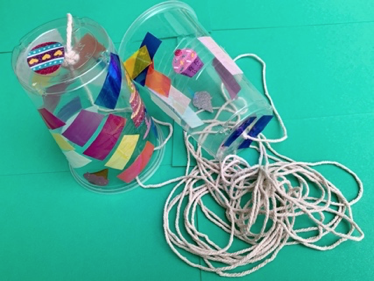

What you’ll need |
|
Method |
Discuss with the child how they think the message gets from the mouth to the listener’s ear. Help your child to understand that when you speak into the cup the vibrations of your voice cause vibrations to travel along the string to the other cup as sound waves. This allows you to hear what the other person is saying. Does the game work if the string is loose? Can you hear the message if you are far away from the other end? Can you hear if the message is whispered? |
What did we learn? | What did we learn? Communication and language:
Understanding the world
|
Activity 3 - Feely bag game
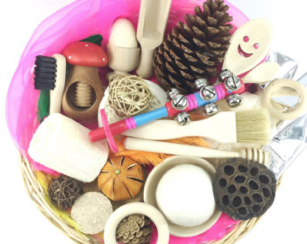
What you’ll need | A range of items of different textures eg: hard, soft, squashy, furry, bumpy, spiky etc. A bag. |
Method | Go around the house with your child collecting small items of different textures and lay them all out for your child to see (around 8 items should be enough). First of all encourage your child to touch each item and describe its texture (model these words if they are not sure). Place the items together in the bag and take it in turns to close your eyes and place your hand inside, describe the texture and guess the item. |
What did we learn? | Expressive arts and design: Exploring and using media and materials Beginning to be interested in and describe the texture of items. Mathematics: Shape, space and measures – Beginning to catergorise objects according to properties eg: shape, size, texture. Personal, social and emotional development: Making relationships – Keeps play going by responding to what others are saying or doing. |